14 Poetry of the Romantic Era
Poetry of the Romantic Era
Love and romance is a common theme in poetry and music. Consider these pieces from the Romantic Era, then consider what modern poetry or music might be viewed in a similar way in the future. How do these pieces speak to the beliefs of the people of the Romantic Era? How do they fit in the time of the transcendentalists?
“Last Words on Greece” by Lord Byron
What are to me those honours or renown
Past or to come, a new-born people’s cry?
Albeit for such I could despise a crown
Of aught save laurel, or for such could die.
Of thine to me is as an adder’s eye.
To the poor bird whose pinion fluttering down
Wafts unto death the breast it bore so high;
Such is this maddening fascination grown,
So strong thy magic or so weak am I.
First published, Murray’s Magazine, February, 1887, vol. i. p. 146

Byron was a modern-style pop culture celebrity. His behavior was considered scandalous, and this brought him fame and often trouble. He married, but they quickly separated, and Byron had a series of affairs; his affairs with women are documented, though it is suggested that he had affairs with young men, as well, one of whom he left money in his will. He traveled extensively and develop passion for causes and people as a result.
Adapted from “Lord Byron.” by Wikipedia is licensed CC BY-SA 4.0.
“She was a Phantom of delight” by William Wordsworth
She was a Phantom of delight
When first she gleamed upon my sight;
A lovely Apparition, sent
To be a moment’s ornament;
Her eyes as stars of Twilight fair;
Like Twilight’s, too, her dusky hair;
But all things else about her drawn
From May-time and the cheerful Dawn;
A dancing Shape, an Image gay,
To haunt, to startle, and way-lay.
I saw her upon nearer view,
A Spirit, yet a Woman too!
Her household motions light and free,
And steps of virgin-liberty;
A countenance in which did meet
Sweet records, promises as sweet;
A Creature not too bright or good
For human nature’s daily food;
For transient sorrows, simple wiles,
Praise, blame, love, kisses, tears, and smiles.
And now I see with eye serene
The very pulse of the machine;
A Being breathing thoughtful breath,
A Traveller between life and death;
The reason firm, the temperate will,
Endurance, foresight, strength, and skill;
A perfect Woman, nobly planned,
To warn, to comfort, and command;
And yet a Spirit still, and bright
With something of angelic light.
Composed 1804.—Published 1807

Stanzas [“Oh, come to me in dreams, my love!”] by Mary Wollstonecraft Shelley
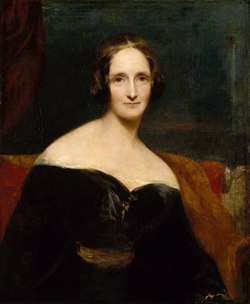
Mary Wollstonecraft Shelley. Richard Rothwell’s portrait of Shelley was shown at the Royal Academy in 1840, accompanied by lines from Percy Shelley’s poem “The Revolt of Islam” calling her a “child of love and light.” Wikipedia Contributors..
Shelley is perhaps most famous for having written Frankenstein and for having been married to fellow writer Percey Bysshe Shelley. Her relationship with Shelley began while he was married to another, and it was only after his first wife’s suicide and the death of Mary and Percey’s premature child that they were able to marry. The two embodied much of the Romantic movement, including pursuing close friendships with other artists, like Lord Byron, and being involved in scandal. She was the second child of the feminist philosopher, educator, and writer Mary Wollstonecraft and the first child of the philosopher, novelist, and journalist William Godwin.
Adapted from “Mary Wollstonecraft Shelley” by Wikipedia is licensed CC BY-SA 4.0.
Question to Consider: How do these pieces speak to the beliefs of the people of the Romantic Era? How do they fit in the time of the transcendentalists? Then, consider a modern poem or lyrics and explain why the piece will be considered indicative of the way current society views love. What makes the piece unique to this time?